Why are your search impressions declining even when rankings stay the same?
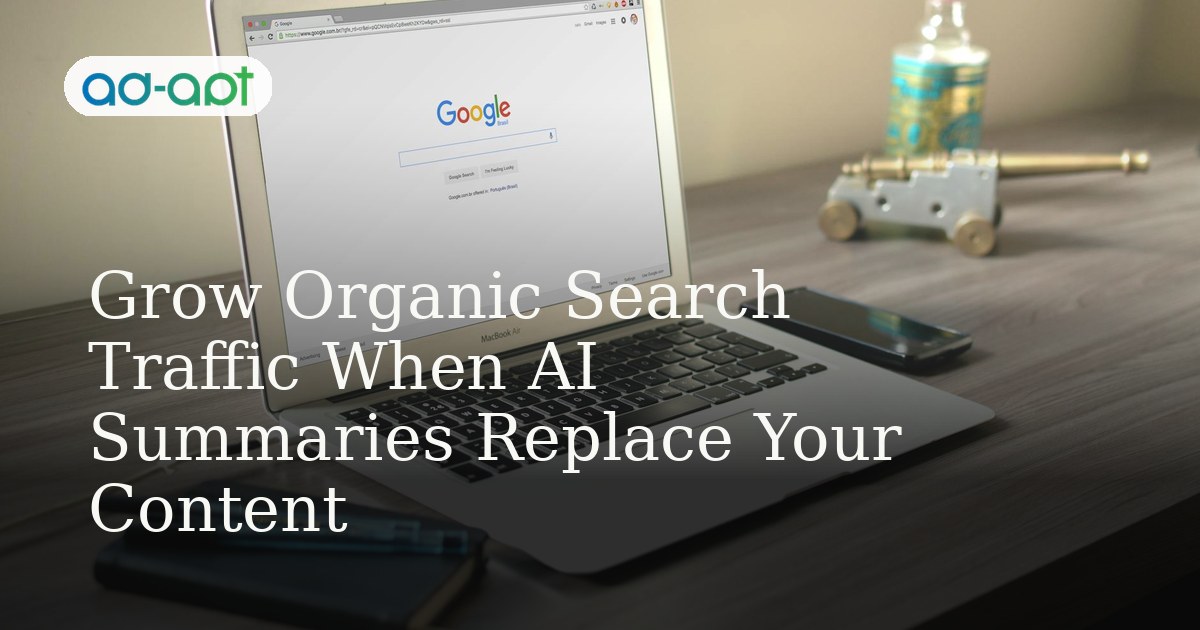
Google's AI Overview and similar zero-click features now answer questions directly on the search results page—without requiring a click. Your content ranks well, but users never reach your site. This isn't a ranking problem; it's a visibility problem. When Google extracts your answer and displays it in the SERPs, you lose the traffic velocity that built your audience.
The root issue: generic, answer-first content gets summarized. If your piece is structured to lead with a conclusion, AI summaries compress it further. Users read the summary, their question gets answered, and they scroll away. You've become infrastructure for Google's product, not a destination.
Winning back traffic means shifting from "answer the question" to "become essential to understanding it." That requires a structural change: move from single-answer formats to multi-dimensional content frameworks that demand navigation, cross-reference, and return visits.
What content structure survives zero-click results?
Content that AI summaries cannot compress is content that requires navigation, judgment, or comparative analysis. Three patterns work consistently:
- Decision trees and methodology frameworks. A post that walks through a decision workflow—"If X, then evaluate Y; if Y fails, test Z"—cannot be reduced to a single summary. The user must visit to make their specific decision. Example: instead of "What is ROAS?" write "How to Calculate ROAS for Paid Search vs. Affiliates vs. Organic" and structure it as a comparative branch.
- Primary data and proprietary analysis. Summaries cite sources; they don't replace them. If you publish original benchmarks, surveys, or cost breakdowns, AI systems will link to your work as the reference source. A generic "average SaaS customer acquisition cost is $800" gets summarized; your "$847 across B2B SaaS, $540 in B2C, $1,200+ in healthcare" becomes the cited source. We saw this firsthand at Teton Gravity Research—proprietary gear data and location testing became the authority layer that travel aggregators pulled from, not replaced.
- Workflow guides with conditional outputs. Instead of "How to set up Google Analytics 4," write "GA4 Setup Checklist: E-commerce vs. SaaS vs. Publishers" with branching checklists. The user must navigate the structure to find their specific path. AI can summarize one path; it cannot compress the entire conditional framework.
The shared principle: your content becomes more valuable to cite than to summarize when it requires interpretation, selection, or navigation by the reader.
How do you build an audience beyond search rankings?
Relying solely on organic search visibility leaves you vulnerable to algorithm shifts and zero-click result expansion. The content that survives—and grows—does three things simultaneously:
First: become a referenced authority in your verticals's knowledge graph. This means publishing data others cite (original research, benchmarking, cost analysis) faster than competitors. When your content appears in industry Slack channels, Reddit threads, and professional tools as "the source," Google indexes that signal. At Circle K, we built proprietary BigQuery models for car wash operations that became the reference layer competitors quoted—which increased both direct traffic and media mentions.
Second: embed content in tools and workflows, not just web pages. A Mint Life built Zoho CRM blueprints and lifecycle email sequences that pulled their guides directly into client systems. The content didn't sit in a blog; it lived in the tool users opened daily. That moves traffic from "search for this topic" to "consult this embedded knowledge base." Organic search becomes secondary—the tool is primary.
Third: distribute through non-search channels with the same content assets. Your decision frameworks, methodology posts, and proprietary data work as LinkedIn threads, email sequences, community posts, and product help docs. When you test a post idea in your audience-first channel (Discord, Slack, your newsletter) before publishing it publicly, you validate demand first. Organic search amplifies existing audience momentum; it doesn't create it cold.
What does this cost in time and resources?
Shifting from "write the answer" to "build frameworks and cite-able data" requires more upfront work per piece. A traditional "how to" post takes 6-10 hours; a decision-tree framework with proprietary benchmarks takes 30-50 hours. The payoff: it generates returns across search, direct visits, citations, and tool embeds instead of declining over time as summaries improve.
The efficient path: start with 2-3 pieces per quarter that meet the criteria above, rather than 12 generic posts monthly. Quality-over-volume works when your definition of quality shifts from "rank-able" to "cite-able and navigate-able."
Carcin demonstrated this with its carcin.ai productized AI agent operator—they built a framework post about AI-generated content quality, not a generic "what is AI content." It became the reference layer for the category because it included methodology, conditional recommendations, and real output samples. That's cite-able. That survives summary compression.
Your next move?
Audit your top 20 organic traffic sources by answer type. How many are generic single-answer pieces? How many require navigation, decision-making, or data interpretation? For every generic answer post losing clicks to summaries, replace it with a framework version: branch it into use-case paths, add proprietary data, embed it into a product or tool where applicable. Track not just clicks, but time on page, return visits, and external citations. That's your growth signal in a zero-click world.